

We may earn money or products from the companies mentioned in this post.
Located in the Lazio region of Italy, Civitavecchia pronounced ‘Chee-vee-ta-vek-ee-uh’ is one of the busiest Mediterranean commercial seaports. If you are approaching Rome by water on a cruise liner, you will have to get down at the Civitavecchia port before proceeding to Rome, which is an hour away by road. That’s what most travelers do. The lesser-known Civitavecchia is a port city with many attractions of tourist interest. How about spending some time in Civitavecchia?
Civitavecchia has a rather interesting timeline. The term ‘Civitavecchia’ means ancient town. It was here, where the Etruscans lived, followed by Romans ruling it around 100 A.D. It flourished under the rule of Roman emperor Trajan who named it Centumcellae. Civitavecchia was under Papal rule from 1432 till Pope Innocent XII liberated it in the late 17th century. The World War II aerial bombardments ruined the city completely.
Skip to the present, there is lots to see and do in Civitavecchia. No attraction in Civitavecchia is too far from the other. Extremely walkable and easy-to-maneuver streets have some very interesting things for intrepid explorers to explore. A day or two is sufficient to get the feel of the lesser-known city of Civitavecchia.
Things to Do in Civitavecchia

Civitavecchia Port
The extremely busy Civitavecchia Port is over 2000 years old. Besides commercial ships, some popular cruise liners can be seen. If you are into ships, Civitavecchia Port is just perfect to view the ships come in and go. Luxury yachts can be spotted. The port is massive, so you should have an idea of what is in store for you. The port’s new cruise terminal has a small museum where you get to see ancient artifacts not only from the region of Lazio but also from the Viterbo region, Etruria region, and Rome.

Mercato delle Vettovaglie
The popular ‘Mercato delle Vettovaglie’, a shopping market, has around 230 stands and 24 shops selling fresh food items, veggies, and poultry. The market is open from 7:00 a.m. to 2:00 pm, every day except Sundays. Also called the Central Market, wander through the stands and shops, perhaps grabbing a coffee and pastry for breakfast.

Michelangelo Fortress
The most dominating building of Civitavecchia is the Michelangelo Fortress built on the order of Pope Julius II. Bramante was the designated architect whose work can also be seen in the Vatican. After his death, the construction was supervised by Michelangelo. ‘Fortezza Michelangelo’ as the Italians call it, was completed in the 16th century.
The fort was built to protect Civitavecchia from pirate attacks. Some of its walls are as thick as 6 meters (20 feet), and the top is strong enough to support cannons. Inside is a small chapel dedicated to Santa Fermina. Underneath the Tower of St. Sebastian, there is a secret passage into the city.
Presently it serves as the headquarters of the Port Captaincy. As you walk around its periphery, you get to see some sweeping views of the Mediterranean, fishing boats, and some cafes and shops.
Museo Archeologico Nazionale di Civitavecchia
Much smaller compared to many museums in Italy, the National Archaeological Museum of Civitavecchia, also called the City Museum, is one of the must-see tourist attractions of Civitavecchia. The building dates back to the 18th century and was constructed on the orders of Clemente XIII to serve as a garrison.
The 3-storied building has artifacts from the ancient Etruscan civilization and the Roman period. Most notable is a 2-meter tall 1st century AD statue of Apollo that was unearthed in 1959. You get an insight into the evolution of the fascinating Mediterranean culture. The museum has many archeological finds, which were excavated from Taurine Bath, La Mattonara Necropolis, Punta del Pecoraro, and more!

Cathedral of Saint Francis of Assisi
One of the most visited attractions of Civitavecchia is the Cathedral of Saint Francis of Assisi. Also called St. Francis Cathedral and Civitavecchia Cathedral, it is the main church of Civitavecchia. It was built on the remains of a small Franciscan church in 1610, then rebuilt by order of Pope Clement XIV in 1805.
The building was left in ruins after getting bombarded in World War II but was restored to its past glory in the year 1950. On top of the building is a cross, a statue of Saint Francis on one edge, and on another edge is the statue of Saint Anthony of Padua. Inside the church, you get to see some frescoes, religious figurines, scenes, and tableaus commemorating Biblical characters and events.

Chiesa dei Santissimi Martiri Giapponesi
‘The Church of Holy Martyrs of Japan’ or as the locals call it: Chiesa dei Santissimi Martiri Giapponesi, is an interesting find. The building is certainly not inviting, but once you enter, you shall get to know some interesting facts about an unfortunate event.
In 1597, twenty-six Franciscan monks were executed in Nagasaki. This church is exclusively dedicated to them. Portraits of all of them hang here. Luke Hasegawa, a Japanese artist, was commissioned to paint them. Besides paintings, you get to see frescoes and mosaics. On its facade, just a few feet from the entrance, you shall spot a statue of a Japanese man.

Chiesa della Stella
Primarily Chiesa della Stella is known for the wooden statue of the Virgin Mary. The frescoes you see in the church were painted in 1996 by a local artist. The church is well known for its Good Friday procession, referred to as the ‘Ancient procession of the dead Christ,’ that’s when some of the unseen artifacts and relics of the church are displayed to the public. It’s quite an event. If you are in Civitavecchia on a Good Friday, head to Chiesa della Stella.
Terme Taurine aka Terme di Traiano
About 3 miles (5 km) from the city center, you have to take a bus, taxi, or rent a car to reach Terme Taurine. The complex has Roman thermal baths. These structures were built on hot sulfur spring water which flowed there once upon a time. However, now it is completely dry.
You can see some well-preserved mosaic tiles, bathing areas, and massage rooms. According to archaeological evidence, some of the baths were built close to the 1st century BC whereas others were built by emperor Hadrian from 123 to 136 AD. If you wish to see and relax in hot sulfur water springs, very close to the complex is Terme della Ficoncella which offers relaxing spa and wellness treatments.

The Wall of Urban VIII and the Fountain of Vanvitelli
Facing the Mediterranean Sea, the imposing ‘Wall of Urban VIII’ was built in the 17th century as a defensive wall to protect Rome against pirate attacks. In the year 1743, on orders of Pope Benedict XIV, a beautiful fountain was built right in the center of the wall. The fountain was designed by Luigi Vanvitelli, after whom the fountain has been named. Constructed using the sturdy Travertine stone, the highlight of the fountain is a very angry-looking mythical creature, looking like a faun who spews out water from its mouth.

Piazza Leandra
The popular and one of the oldest public squares, Piazza Leandra, has some interesting sights to offer. The old fountain in Piazza Leandra was completely destroyed in WWII but now has been restored. Cobbled streets and old lamp posts give character to the square. The Church of Stella overlooks the square.
Another point of interest is the House of Remembrance, where you see some vintage photos of Civitavecchia as well as paintings by different artists. Just a few steps from Piazza Leandra is the well-known Passaggio dell’Archetto (little archway) built in medieval times.
Palazzo Manzi
Displayed inside the 5-storied building of Palazzo Manzi, is some precious art. The paintings you see there were found embedded under multiple layers of lime and paint accidentally discovered during the restoration process. The mystery remains about who drew them and in which era they have been painted. They are quite similar to some paintings painted by the renowned Italian artist Raffaello Sanzio in the Vatican apartments of Pope Julius II.

Chiesa di Santa Maria dell’Orazione e Morte
Located in the old town, the baroque-style cathedral Chiesa di Santa Maria dell’Orazione e Morte was built in 1685. The literal English translation of Chiesa di Santa Maria dell’Orazione e Morte is ‘The church of prayer and death.’ The significance of its name is praying for the seamen who died and never returned. Through the years, many controversies and supernatural events surrounding the church have been a topic of hot debate in the Vatican.
Beachfront and Promenade
The promenade starts from the Michelangelo Fortress and goes all the way to Pirgo. Located right on the beach, the promenade houses restaurants and bars, children’s equipment, and rides. You can spot many locals basking in the sun as well as lounging on sunbeds and umbrellas.
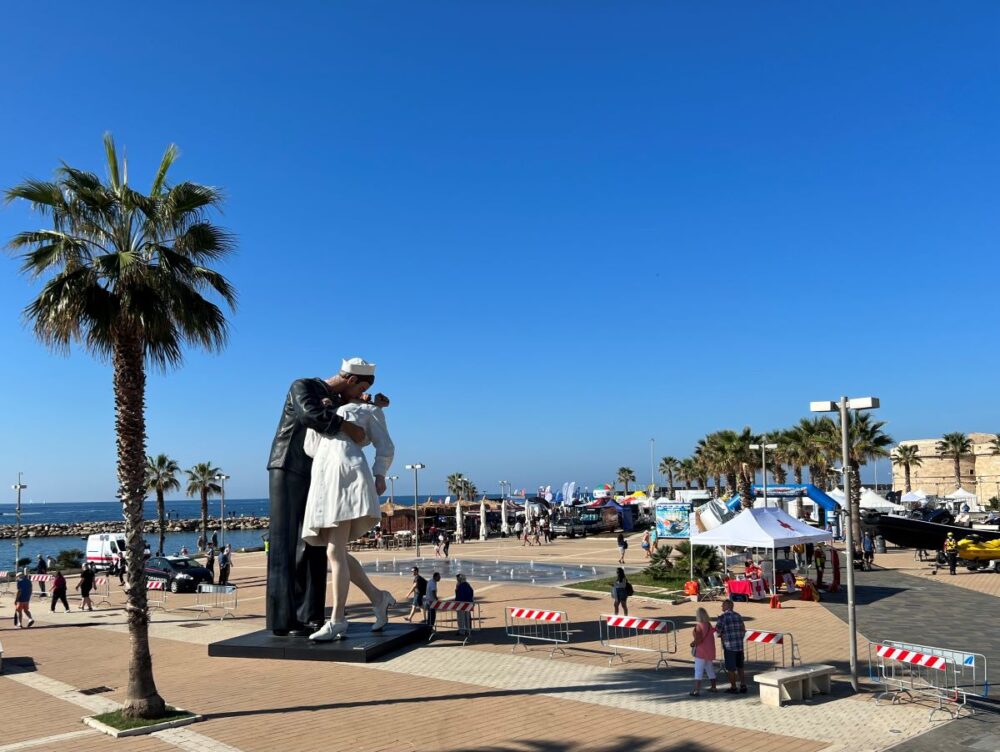
Statue of Unconditional Surrender
Placed right in the center of the promenade, the 25 feet tall statue ‘Statue of Unconditional Surrender’ is a must-see. Its sculptor Seward Johnson took inspiration from the extremely famous photograph by Alfred Eisenstadt, the one in which an unidentified navy sailor is seen kissing an unidentified nurse on New York’s Times Square in 1945, celebrating Japan’s surrender in World War II. Don’t forget to take the obligatory selfie with the statue in the background!

Experiences in Civitavecchia
Shop local products
If you love wine, don’t miss out on buying wine bottles. They are much cheaper compared to other Italian touristy towns. A bottle of Sambuca is a good buy. For things ranging from clothing to home decor and other nicknacks, head to San Lorenzo Market, Mercato di Civitavecchia, or Corso Centocelle. The markets are closed on Sunday.
Drink and Dine
You can feast on good Italian food at extremely reasonable prices in Civitavecchia. Besides cuisine, Civitavecchia is known as the birthplace of Sambuca. Made out of Anise, it is essentially a digestif drink with a strong flavor. Some prefer it neat, while others like to have it with coffee beans. Then there are Sambuca cocktails and the Sambuca Espresso Martini.
Take a cooking class
Cooking classes in Civitavecchia are extremely popular, and people absolutely love them. You get to learn to cook some local dishes. It usually starts with a shopping experience where you buy ingredients, followed by a friendly chef guiding you on how to cook them. Usually, it is a small group and mostly held in the homes and restaurants of the host.

Walking Tours
No four-wheeler can beat exploring a city on one’s own two legs. Opt for a tour or just move around at your own sweet speed. Trees lining up the roads provide ample shade, keeping you cool and comfortable.
If you take the time to explore on your own, don’t miss going through some of the smaller back streets and alleys. You’ll find murals along the way.
Enjoy a show at Teatro Traiano
Enjoy a show at Teatro Traiano (Trajan Theater), located in a prestigious building, to understand the local culture of Civitavecchia. The theater was inaugurated in 1844, making it the oldest theater in all of Italy.
Where to Stay in Civitavecchia
If you’re planning on taking a cruise that ends or begins in Rome, then plan on spending a night in Civitavecchia to explore the city. The town does not have too many hotels, but it is abundant with apartments and other property rentals.
Luxury: La Casa Sul Mare: Guests praise the spectacular views from the private balconies. This hotel is located within easy walking distance of all the highlights – the train station, restaurants, and the beach.
Mid-Range: Hotel Porto Di Roma: Recently updated, guests praise the staff and the facilities. Staff are great at making recommendations of things to see and do. Guests can walk to restaurants and the port.

Final Thoughts on Things to Do in Civitavecchia
Whether you’re stopping in Civitavecchia or leaving from Civitavecchia on your cruise, take some time to explore it and skip traveling to Rome. Rome deserves its own three-day visit, so relax and take your time and relax in Civitavecchia instead.
Have you visited? What did you enjoy the most?
Check out these other related posts:
- Tips for Visiting Rome for First-Timers
- A First-Timer’s Guide to Venice
- A Guide to Trieste, Italy
Happy travels,
Annick, The Common Traveler


 Raised as a third culture kid living in South America and Europe, Annick caught the travel bug early. As an empty-nester, Annick enjoys sharing her tips for traveling for those with champagne taste and beer budgets.