

We may earn money or products from the companies mentioned in this post.
A friend visiting Iceland in February several years ago posted photos of herself snorkeling the Silfra Fissure in Iceland. From that moment on, I knew that snorkeling the Silfra Fissure was on my bucket list. The tour costs a lot of money, so you’re probably wondering, is snorkeling the Silfra Fissure in Iceland overrated?

What is the Silfra Fissure?
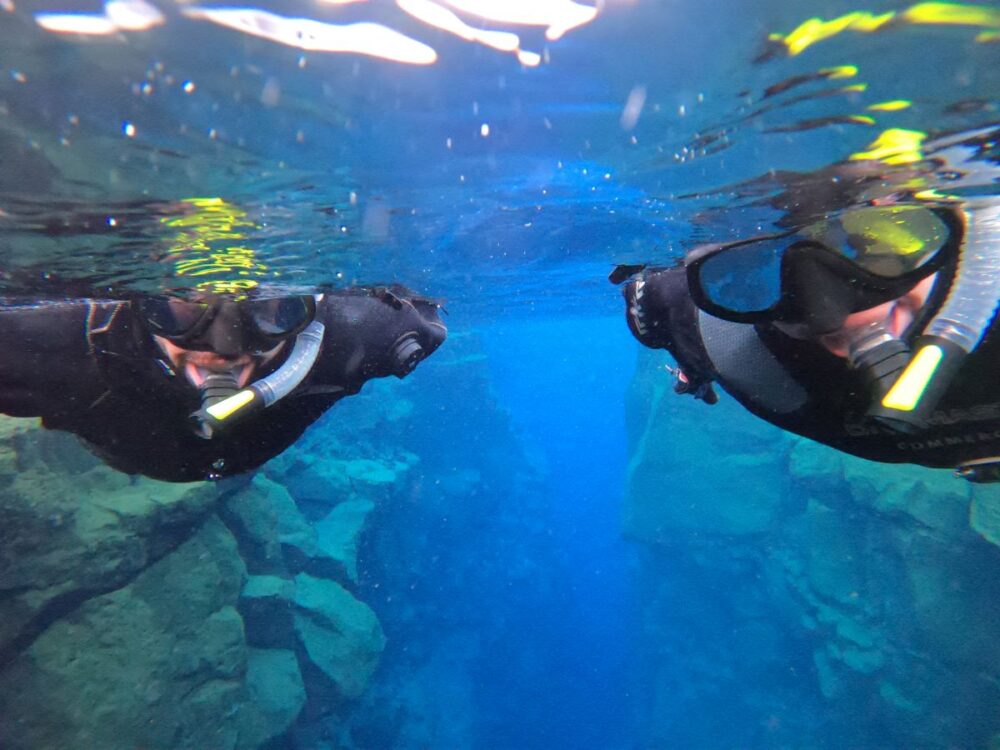
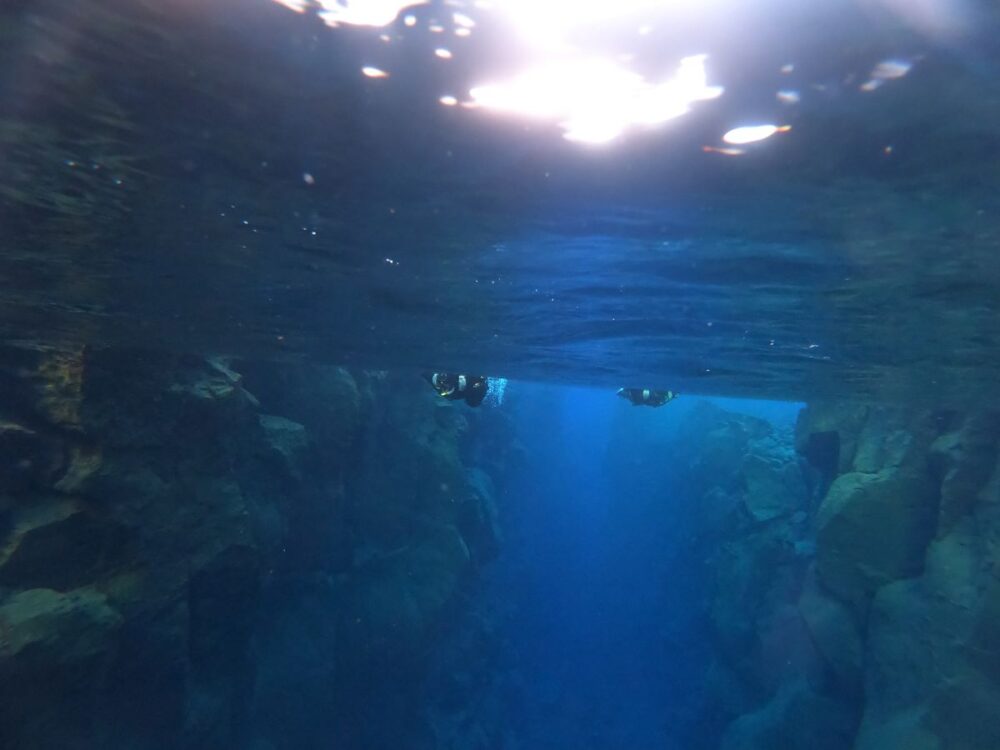
Located in the Þingvellir National Park, in the Pinvvallatn Lake, Silfra is one of the fissures where the North American and Eurasian tectonic plates meet. The fissure is deep underwater, so divers get the best view, but snorkeling the fissure is also worth trying.
The water temperature remains constant all year – from 35 to 39 degrees F. The water is crystal clear, and while not many fish like this spot, the natural grasses, and rock walls are enough to hold your attention.
How to prepare for snorkeling the Silfra Fissure
Each tour company has recommendations you should follow before snorkeling the Silfra Fissure. We chose Arctic Adventures for our tour. Most tour companies give you the option to pick you up in Reykjavik (at or near your accommodations) or meet at the Þingvellir National Park. We opted to have a city pick-up.
The tour company bus picks up at various meeting points in town. Our stop was Bus Stop #9, which was located in front of a sister property Center Hotel Lauvagevur, just a block and a half away from our Midgardur Center Hotel. The minivan stopped at various places throughout town, making it convenient for most visitors.
Before you book your tour, review the requirements to ensure you can participate. For example, children under 12, weak swimmers, and some medical conditions cannot safely engage in this activity. Visitors will be exposed to water temperatures around 2 degrees Celsius, where face, hair, and hands will get wet.
What to expect snorkeling the Silfra Fissure
You’ll start by stripping your outer layers. Arctic Expeditions provided an undersuit to put over our thin fleece base layer. Next, we had to put on the neoprene dry suit. This made it hard to move! The outfit comprises a hood, gloves, masks, snorkel, and fins.
Once dressed, you’ll walk about 150 meters to steps that take you into the water. You’ll have a few minutes to adjust equipment before you begin your journey.
Yes, your face will be in the cold water! But you should be able to tolerate it. You can always rotate your face out of the water for a break if needed. In our case, the water was warmer than the outside temperature. The first half of your adventure will be like a lazy river. The current slowly drifts you farther away. You can admire the plants and extremely clear water while relaxing and enjoying the view. There is an additional exit in the shallow area in case guests change their minds about continuing on the adventure.
The second half of the water portion (expect to be in the water for about 30-45 minutes) will have you swimming against the current for a bit. Exit the stairs located about 350 meters from your starting point. You’ll have to walk back again in the restrictive clothing.
Because the water averages 2 degrees Celsius, you should prepare by hydrating and eating before your tour – you’ll need the energy! At the end of your journey, your reward is a steaming cup of hot chocolate and cookies.
But any description of the experience cannot do it justice.

My experience snorkeling the Silfra Fissure in winter
I’m almost 55 years old and overweight. While I regularly exercise and have no current health issues, I wondered if I was fit enough to complete this snorkeling adventure. I went into the experience with a positive, though apprehensive, attitude, as this has been on my bucket list for several years.
While putting on the jumpsuit and dry suit, wear your gloves and hats. I made the mistake of taking them off. My fingers were so frozen that I could not help pulling my dry suit on. No matter how hard they try to get the best fit, water will enter inside your gloves and inside your hood. Areas of your face not covered by the mask or hood will be in that cold water. Your body temperature will warm up any water that gets into your gloves and hood, so you’ll be fine other than frozen hair at the end.
Be aware, though, that not all dry suits will remain dry. In my case, I lifted my head too fast early on, causing a small leak at the neckline, and water infiltrated inside my suit. We were still in the shallow area, so I asked my guide, Guy, whether I should keep going. As with the other sites that got wet, he assured me that my body would warm up and I was safe to keep going.

I found it challenging to track where everyone from my group was in relation to me. I worried too much about whether I had ventured into an area where I shouldn’t be instead of relaxing and enjoying the ride.
That last little bit? Where you have to swim against the current? That was the hardest thing I’ve had to do in a while! Your dry suit is so buoyant that you’re staying on top of the water with the current pushing against you. The wind was intense the day we visited (-18 degrees Celsius or about 0 degrees Fahrenheit, not counting the windchill!). The last bit was challenging, and our guide towed in two of my fellow snorkelers.
My body temperature dropped enough that I didn’t feel well. I was lightheaded and dizzy after getting out of the water. I had a change of clothes for the bottom but not my bra and top – so bring an extra set of everything! My hand warmers were perfect for raising my body temperature.

Is snorkeling the Silfra Fissure in Iceland worth it?
Snorkeling the Silfra Fissure in Iceland was well-rated and was worth it. While it may not be the only fissure between the two tectonic plates you can visit, it is undoubtedly the most unique. You can snorkel anywhere, but snorkeling in Iceland at the Silfra Fissure was unlike anything else I’ve ever experienced, and I highly recommend it! Just be prepared for the cold, and maybe try this in summer!
What do you think? Would you add snorkeling the Silfra Fissure to your bucket list? Or did you have a different opinion? Share with me!
Check out more Iceland content here:
- Things to Know Before Visiting Iceland in Winter
- A 4-Day Itinerary for Iceland in Winter
- Packing for Iceland in Winter
- Lagoon Etiquette: What you need to know!
Happy travels,
Annick, The Common Traveler
Save this Is snorkeling the Silfra Fissure in Iceland worth it? for later – pin it and share it!




 Raised as a third culture kid living in South America and Europe, Annick caught the travel bug early. As an empty-nester, Annick enjoys sharing her tips for traveling for those with champagne taste and beer budgets.